
Mason Property Tax Record Fields
Mason County property tax records pull from two offices. Local assessors and Equalization maintain the assessment data. The Treasurer keeps the billing and delinquency side. A single parcel card can list several years of tax rows, so match each figure to its year and its keeper.
| Field | What It Shows | Where |
|---|---|---|
| Assessment and SEV | Local and equalized figures | LIAA card |
| Taxable value | Capped or adjusted tax base | LIAA and BSA |
| PRE | Principal residence exemption percentage | Parcel card |
| Tax rows | Summer, winter, village, and status details | BSA and Treasurer |
| Delinquency | Payoff, foreclosure, and sale stage | County Treasurer |
Michigan starts from true cash value, then generally assesses at half of it. Equalization turns that figure into SEV. Taxable value is the capped base that actually drives the bill. A transfer can uncap it in the next cycle. So a property's tax value and its sale amount often part ways.
Read Mason's 2026 Values
The inspected parcel card gives a concrete tax-record example.
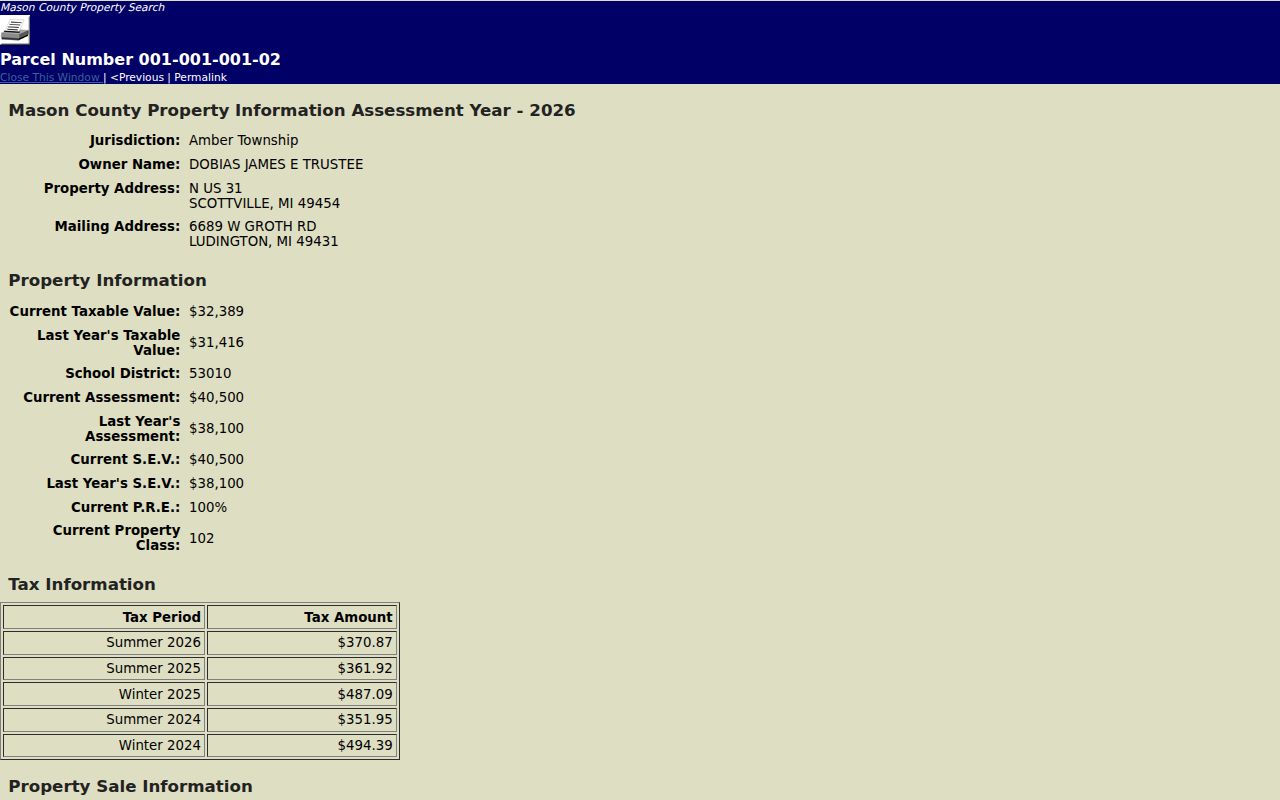
One 2026 Mason County card shows how the model works: assessment and SEV of $40,500, taxable value of $32,389, and a 100 percent principal residence exemption. It illustrates the three-value structure. It proves nothing about countywide trends.
- Assessed value
- The local assessor's figure.
- SEV
- Value after equalization.
- Taxable value
- The tax base.
- Millage
- Levies per thousand dollars of taxable value.
Mason Equalization and Treasurer
Mason County Equalization supports uniform assessment, parcel maintenance, GIS, aerial and tax maps, and split or combine work. Property condition is measured as of December 31 for the coming cycle.
The Treasurer keeps permanent tax rolls, handles delinquency, certifies deeds for taxes, and administers foreclosure. Its source pictured below confirms the online and office split.
The image confirms parcel GIS and assessment-support services.
Look Up a Mason Tax Bill
The Treasurer tax-record page points to BSA for owner, address, values, PRE, taxes, sales, and building data. BSA access is not always available, so exact coverage years may vary. LIAA serves as the fallback for current parcel fields.
The image confirms the BSA route and separate tax-history channel.
- Find the parcel in LIAA and copy its number, jurisdiction, and year.
- Open the county-linked BSA record and inspect current and prior rows.
- Compare assessment, SEV, taxable value, and PRE for the same year.
- Call the Treasurer for a current payoff or foreclosure status.
- True cash value
- Michigan's market-value concept.
- Levy
- A tax imposed by an authority.
- PRE
- Qualified principal-residence relief from school operating millage.
- Tax lien
- A claim arising from unpaid property tax.
Mason Delinquent Tax Channels
Call 231-843-8411 for free delinquent-tax and payoff information from the Treasurer. A full tax history, by print or email, costs $1.25 per parcel. Give the parcel number and the exact owner spelling. A payoff figure shifts as interest, fees, and payments post. Note the date and the staff response rather than trusting an old screen.
Summer, winter, and village rows can travel different collection paths. A missing row doesn't mean no tax is due. The Treasurer is the county's final word on delinquent status. A local treasurer may hold a current-year collection before it ever turns delinquent.
Mason Foreclosure Sale Records
The county foreclosure page walks through show-cause and judicial proceedings. It also covers hardship extensions, available defenses, and claims to excess proceeds. These stages carry deadlines with legal consequences.
Mason County stated a specific fact. Parcels owing 2023 and prior taxes were foreclosed by order on April 1, 2026. The county then linked Title-Check and posted a September 25 sale date. Treat every date in that sequence as current only until you confirm it.
The Treasurer's sale notice posts the dated route for foreclosed parcels. Check it again before acting. Availability and sale status change often.
Mason PRE and Transfer Clues
PRE stands for principal residence exemption. The sample card shows 100 percent PRE. But one parcel proves nothing about a full exemption list or a new owner's eligibility. Check current Michigan taxpayer guidance and the local assessor's requirements.
A transfer can uncap taxable value for the next assessment cycle. That timing explains the disagreement. A recent deed, the annual roll, and the current bill may disagree at once. Keep the transfer date handy. Add the assessment year and jurisdiction when asking an assessor about a change.
Mason Assessment Cycle Context
Michigan assessment work reflects a property's condition on December 31. Local rolls then move through equalization, notices, Board of Review sessions, and eventual billing. A deed recorded after the roll's snapshot can be newer than the displayed owner. A transfer may shift taxable value the following cycle.
Build an appeal file with the parcel number. Include the jurisdiction, assessment year, notice date, and every value. Compare similar properties and correct any wrong physical facts. A recorded sale is evidence. Michigan law does not let sale price alone set true cash value. The Michigan Taxpayer's Guide explains how true cash, assessed, equalized, and taxable values relate.
Mason Tax Record Requests
If BSA is down, use the LIAA card for current roll fields. Contact the Treasurer for history or a payoff. Include the parcel number, owner spelling, site address, jurisdiction, and the years you want. Ask how the answer will arrive. It may be a screen print, an emailed history, or a certified record.
Michigan FOIA can reach existing public records that offices do not routinely post. It cannot force a new calculation or a legal interpretation. Describe the record narrowly. Keep proof of submission. Then expect the statutory response process rather than an instant custom report.
A complete Mason County tax file holds the parcel card, assessment notice, bill rows, payment or payoff confirmation, transfer date, PRE status, and any Board of Review filing in one place. Label each document by year. That way a prior roll, a later deed, and a current balance never get mistaken for a single snapshot.
Mason Tax Collection Timeline
Tax records in Mason County come in several forms that people often confuse. Current tax bills, delinquent balances, foreclosure files, and auction notices are separate records. Each answers a different question. Start with the parcel's jurisdiction and the tax year involved. Read every summer, winter, or village row along with its payment status. Then contact the collecting office and ask for a dated balance. Taxes can go delinquent at the county level. The Mason County Treasurer's payoff channel then becomes the stronger source. A printed or emailed history preserves earlier rows. A phone call settles a current payoff question fast.
Foreclosure pulls in more documents. Several items can enter the file. Notices, hearing records, a circuit-court order, hardship material, and possible excess-proceeds forms can all appear. The 2026 county notice covered taxes from 2023 and earlier. It also pointed to a later Title-Check auction route. That dated cycle belongs to those tax years alone. Applying it to another parcel or year without checking the live Treasurer page invites error. Auction listings, sale results, the current assessment roll, and the recorded deed may each follow their own update schedule.
Keep copies of everything. Save the tax history, the payoff response, the foreclosure notice, the court reference, the auction status, and any later recorded instrument. This sequence separates a tax debt from an actual transfer. A parcel on an old sale list does not prove who owns it now. A current roll owner can also lag behind a newly recorded deed.
Assessment and collection records carry different effective dates. The assessment roll reflects the property's condition on the prior December 31. A tax payment can post much later. A newly recorded deed may not yet show as the roll owner. Record the date viewed beside every value, owner field, bill row, and payoff statement. That habit keeps a valid older record from being mistaken for a current one.
A value review calls for real evidence. Gather the notice, the property-card facts, and photographs. Collect comparable sales too. Add evidence that classification or physical data is wrong. The Board of Review judges the assessment under Michigan rules. It does not judge whether the taxpayer can pay. Principal residence exemption questions may turn on separate eligibility and filing facts. Preserve the petition, supporting exhibits, proof of delivery, and the written decision. Later appeal rights can depend on the record built at the local stage.
The sample card shows why every field must be named. Its assessment and SEV of $40,500, its taxable value of $32,389, and its 100 percent PRE belong to one parcel. They describe one assessment year. A recorded sale row at $0 is not automatic proof of market value. The Michigan property-tax framework specifically cautions against relying on a single sale price. A sale price alone is not conclusive true cash value. Weigh the deed terms against valid market evidence before drawing any valuation conclusion.
Before paying or appealing, confirm the parcel number, jurisdiction, and tax year. The owner field must describe the intended property too. Ask the Treasurer or local assessor to explain any conflicting date or status. Retain that dated response with the tax record.
Appeal a Mason Assessment
Assessment challenges in Mason County begin with the local Board of Review. Evidence should address value or classification as of the tax date. Useful materials include comparable sales, photographs, a correct property description, and proof of factual errors. Disputing a bill is not the same as appealing an assessment.
The 2026 state calendar set March organization for March 3, with completion by April 6, plus July and December sessions. Ludington published March 9 and 10 hearings along with July 22 and December 16 sessions. Other Mason jurisdictions can differ, so check the local schedule.
Appeal window. Confirm the current local notice before filing; dates, evidence, and petition rules vary by jurisdiction and year.
The Michigan Taxpayer's Guide explains assessment, equalization, taxable value, transfers, and appeal routes, so keep proof of timely delivery.