
The Values on a Mason County Property Record
Every value in Mason County records needs context. The assessment year, parcel number, jurisdiction, and source all matter. LIAA parcel cards and Treasurer records serve tax administration, while a deed sale reference or an independent appraisal answers a different question altogether.
| Value | What It Is | Where |
|---|---|---|
| Assessed value | Local assessor's mass-appraisal figure | LIAA parcel card |
| State equalized value | Assessed value after equalization | LIAA parcel card |
| Taxable value | Value used as the property-tax base | Parcel card and tax record |
| Recorded sale | Consideration or sale reference for one transfer | Parcel card clue and recorded deed |
Every value in Mason County records needs context. The assessment year, parcel number, jurisdiction, and source all matter. LIAA parcel cards and Treasurer records serve tax administration, while a deed sale reference or an independent appraisal answers a different question altogether.
Three Mason Values, One Card
The sample 2026 card shows an assessment and SEV of $40,500, a taxable value of $32,389, and PRE of 100 percent. It is Michigan's three-value framework made concrete. Assessed value is the assessor's local estimate. SEV reflects equalization across jurisdictions. Taxable value is the base after constitutional and statutory rules apply; review the county-linked sample parcel card with those labels in view.
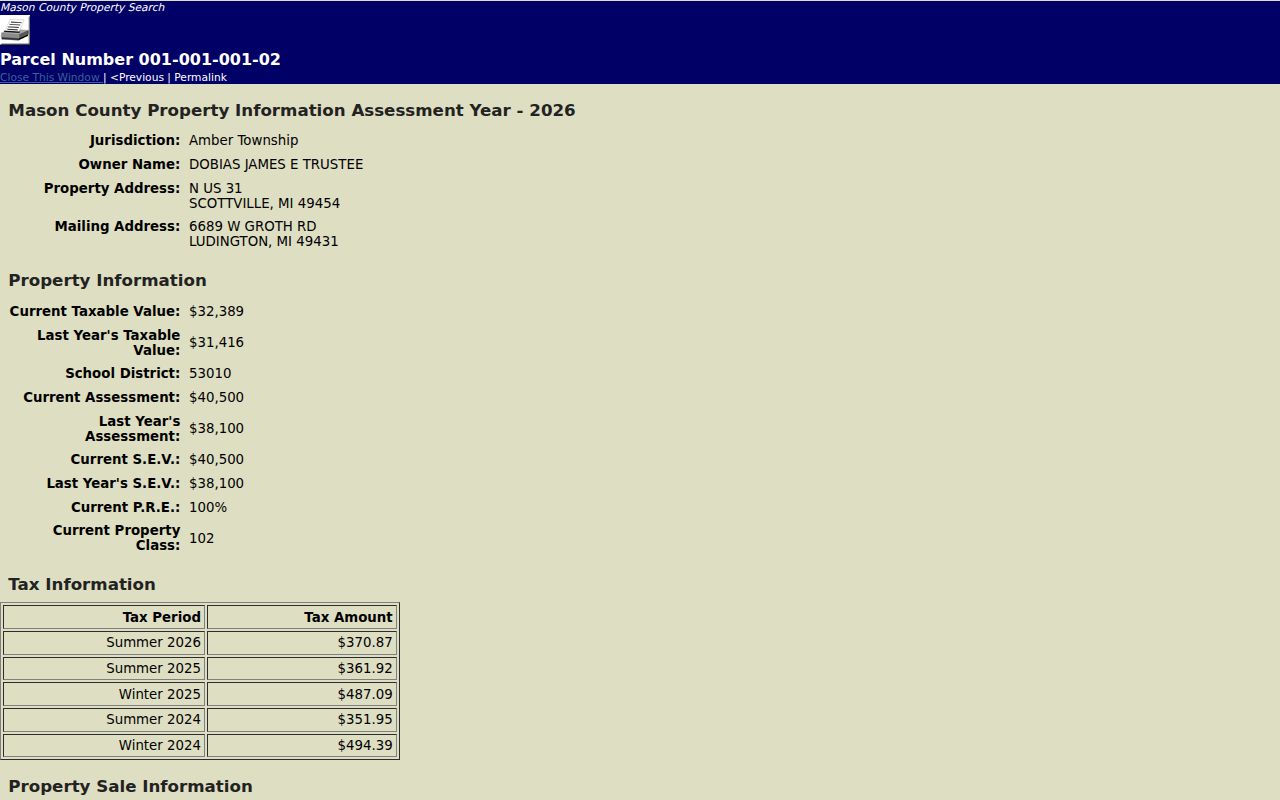
The county's sample card also keeps every value tied to one parcel, year, jurisdiction, and legal description. Those details keep an old value from being mistaken for a current countywide estimate.
Michigan's Fifty Percent Standard
Michigan's General Property Tax Act sets assessed value at 50 percent of true cash value, subject to equalization. The Taxpayer's Guide explains this. That does not make SEV a sale price. True cash value rests on usual selling price under tax law. A real transfer can reflect special terms. Some transfers are not open-market at all. The taxable value can also stay below SEV because of the annual cap. A transfer may uncap it in the next assessment cycle, under the applicable rules. Compare the same year in every case. Ask the local assessor how a specific transfer was treated.
Looking Up a Mason County Property Value
Enter the physical address in the LIAA Mason County Parcel Search. Confirm the parcel and jurisdiction first. Then read the assessment, SEV, taxable value, PRE, tax rows, sale references, and assessment year as separate fields.
- Find the address and verify the jurisdiction.
- Record assessed value, SEV, taxable value, and year.
- Note PRE and any transfer or split clues.
- Open the deed for a sale amount or consideration context.
- Use an independent appraisal for a current market opinion.
- Assessed value
- The assessor's value under the property-tax system.
- Market appraisal
- An opinion of current market value for a specific purpose and date.
- Assessment level
- The statutory relationship between assessment and true cash value.
Mason Sale Prices Need Context
The sample card lists a September 2022 transfer at $0 with reference 2022R05713, and a July 2015 sale of $44,170 with reference 2015R04107. A zero figure rarely means a market price. It can mark a transfer outside the open market. Each reference is a key for the Register of Deeds. It is not proof of the deed's full terms. Use the Mason County deed service to open the instrument and compare consideration, transfer tax, parties, and legal description. Michigan law likewise cautions against treating one sale price as the automatic assessed value.
Mason Values Follow an Annual Cycle
Assessment reflects property condition as of December 31, followed by local assessment and county or state equalization steps. The exact web-update lag for Mason is not published. Date every card. A newly recorded transfer or physical change may not yet appear in the displayed roll.
Assessment challenges begin with the local board of review and follow Michigan's statutory calendar. Ludington publishes city-specific Board of Review dates, while other jurisdictions use their own notices. Route a parcel by its LIAA Jurisdiction field, not its ZIP. See Ludington records and Scottville records for the city split.
Mason County Value Access Routes
The county Treasurer's property-tax records page links to BSA and lists what a card holds: owner, mailing and property addresses, present and prior values, PRE, tax detail, sale information, and building data. When the live BSA interface blocks access, LIAA serves as the dependable route to a current parcel card.
Equalization answers parcel and value questions at 231-845-6288. The Treasurer offers a free delinquency or payoff check by phone at 231-843-8411 and posts a $1.25 per-parcel fee for tax-history printouts or emails. Counter service and a specific Michigan FOIA request remain fallback channels for existing records that are not online.
Value Context Across Mason County
One parcel cannot carry a citywide trend. Ludington's waterfront, harbor, historic additions, and US-10 township edge shape its land context. Scottville's core and re-plats need their own comparisons. The same mailing city can sit in a different assessment jurisdiction. Build the comparison set inside one jurisdiction. Match property class, then legal and physical features. Mason County publishes no citywide appreciation rate and no assessor comparables feature, so no such figure should be inferred from the public card.
What a Mason County Assessor Value Is Not
An assessment or State Equalized Value is a mass-appraisal tool. It is built for tax administration in Mason County. It is not a purchase appraisal. It is not an asking price, a replacement-cost figure, or a promise of what a buyer will pay. Taxable value is narrower still. It only sets the base for computing the tax bill rather than stating current market worth.
When you pull a record, keep the pieces together: assessment year, property class, assessed value, SEV, taxable value, PRE percentage, sale date, instrument reference, parcel number, jurisdiction, and date checked. That single sheet discipline stops figures from blending together. It keeps different years or parcels from becoming one misleading value.
Value versus price. Keep assessment, SEV, taxable value, and recorded consideration in separate columns. For a current transaction, obtain a qualified appraisal and inspect the relevant deed.